Under the relentless sun of China's Xinjiang Uygur Autonomous Region, a monumental battle against desertification is unfolding along the fringes of the Taklamakan Desert, the world's second-largest shifting sand desert. The Taklamakan Desert Edge Stabilization Project represents one of the most ambitious ecological restoration endeavors on the planet, a complex and multi-faceted campaign to halt the desert's relentless advance. This is not a singular, silver-bullet solution but a sophisticated symphony of traditional wisdom and cutting-edge technology, woven together to create a living, breathing barrier against the sands.
The sheer scale of the challenge is daunting. The Taklamakan, often called the "Sea of Death," covers over 330,000 square kilometers, with its dunes constantly on the move, encroaching upon vital oasis towns, farmlands, and the crucial transportation corridors that stitch the region together. For decades, the creeping desert threatened to swallow communities and disrupt the fragile economic lifelines of the Silk Road region. The initial, reactive approaches of simply planting trees often failed, as young saplings were quickly buried or scoured by the abrasive, wind-driven sand. It became clear that a more resilient, integrated strategy was essential—one that could adapt to the desert's harsh logic rather than confront it head-on.
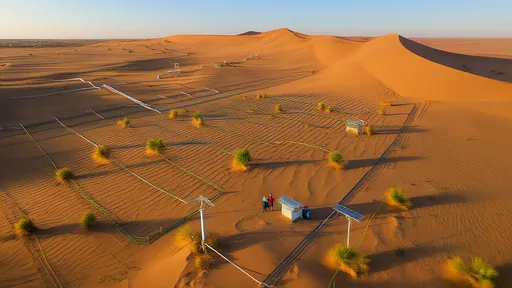
The cornerstone of the project's first line of defense is a surprisingly simple yet profoundly effective technology: the checkerboard sand barrier. This method involves pressing straw—often wheat or reed straw—into the sand in a grid-like pattern, with each square typically measuring one meter by one meter. These humble straw grids perform a miraculous feat of engineering. They disrupt the wind flow right at the sand's surface, drastically reducing its speed and its ability to pick up and transport sand grains. The result is that the once-shifting dunes become stabilized, their movement arrested. This checkerboard lattice creates a stable micro-environment, a sheltered nursery of sorts, which is absolutely critical for the next phase of the operation: establishing permanent vegetation.
Once the sand is temporarily tamed by the straw grids, the meticulous work of planting begins. The species selected are not exotic imports but hardy native plants that have evolved over millennia to survive the Taklamakan's extreme conditions. Saxaul shrubs are the undisputed champions of this effort. With deep-reaching roots that tap into distant groundwater and small, scaly leaves that minimize water loss, saxaul is uniquely equipped for desert life. Its tough, woody structure acts as a permanent windbreak, trapping sand and building up soil layers over time. Alongside saxaul, poplar trees and tamarisk shrubs are also strategically planted, creating a diverse and multi-layered vegetative barrier. This biodiversity is key to resilience; a monoculture is vulnerable to disease or pest outbreaks, whereas a mixed community can withstand shocks and support a more complex ecosystem.
Water, the most precious commodity in a desert, is managed with extraordinary precision. The project relies on a combination of traditional karez systems—an ancient, ingenious network of underground canals that minimize evaporation—and modern drip irrigation. This hybrid approach ensures that every drop of water is used with maximum efficiency, directly hydrating the root zones of the young plants without wastage. The goal is not to create a lush, water-intensive forest, but to establish a self-sustaining xerophytic, or drought-tolerant, ecosystem that can eventually survive on natural rainfall alone. The careful water management is a testament to the project's long-term vision, aiming for sustainability rather than a temporary fix.
Beyond the straw and the saxaul lies a layer of high-tech surveillance and analysis. The project employs a sophisticated monitoring network that includes remote sensing satellites, drones, and ground-based sensor arrays. These tools provide scientists and engineers with real-time data on a vast range of variables: vegetation health, soil moisture content, dune movement patterns, and wind dynamics. This data-driven approach allows for adaptive management. If a particular section of the green belt is struggling, resources can be redirected. If a new pattern of dune movement is detected, preventative measures can be implemented proactively. This fusion of boots-on-the-ground effort with an eye-in-the-sky perspective represents the modern face of ecological engineering.
The impacts of this massive undertaking are already becoming visible and are far-reaching. The most immediate effect is the creation of a stable physical environment. Dust storms, which once regularly choked cities like Kashgar and Hotan, have seen a noticeable reduction in frequency and intensity. The stabilized land has allowed agriculture to rebound on the desert's edge, securing livelihoods for local farmers. Perhaps one of the most significant, yet less visible, benefits is the protection of critical infrastructure. The Tarim Desert Highway, a vital artery for oil and gas extraction and regional transportation, now runs for hundreds of kilometers between two parallel rows of shelterbelts, a green corridor defiantly cutting through the yellow sea of sand, ensuring this economic lifeline remains open.
However, the project is not without its profound challenges and ongoing debates. The primary concern revolves around water security. The Tarim Basin's water resources are finite, fed by melting glaciers from surrounding mountains. As climate change accelerates glacial retreat and alters precipitation patterns, the long-term viability of relying on irrigation is called into question. Critics argue that large-scale afforestation in an arid zone could potentially lower groundwater tables, affecting downstream users and the natural riparian ecosystems along rivers like the Tarim. The project's managers are acutely aware of this, and the focus has increasingly shifted towards selecting even more drought-resistant species and perfecting water-conservation techniques to minimize the ecological footprint.
Looking forward, the Taklamakan Desert Edge Stabilization Project is evolving from a purely defensive barrier into a more holistic vision of sustainable development. There is growing interest in exploring the economic potential of the green belt itself. The saxaul forests, for instance, are not just ecological tools but potential resources. The shrubs can host Cistanche deserticola, a valuable parasitic plant used in traditional Chinese medicine, offering a potential source of income for local communities. Furthermore, the stabilized lands are being considered for the cautious development of ecotourism and even the installation of solar farms, leveraging the region's abundant sunlight. This "ecological industry" model aims to create a virtuous cycle where environmental protection generates economic benefits, which in turn fund further conservation efforts.
The story unfolding at the edge of the Taklamakan is more than a technical manual on desert control; it is a powerful narrative of human perseverance and adaptation. It demonstrates that the fight against desertification is not a war to be won with a single decisive battle, but a long-term campaign of careful coexistence. By blending the time-tested simplicity of straw checkerboards with the data-driven power of satellites, and by marrying the resilience of native species with a vision for sustainable economic growth, China is writing a new chapter in the history of humanity's relationship with its most arid landscapes. The lessons learned here—in integration, adaptation, and patience—are proving invaluable, offering a template of hope for other arid regions around the world grappling with the expanding threat of desertification.

By /Oct 21, 2025

By /Oct 21, 2025
By Emily Johnson/Oct 21, 2025
By /Oct 21, 2025
By /Oct 21, 2025
By /Oct 21, 2025

By /Oct 21, 2025

By /Oct 21, 2025

By /Oct 21, 2025
By /Oct 21, 2025

By /Oct 21, 2025

By /Oct 21, 2025

By /Oct 21, 2025

By Natalie Campbell/Oct 21, 2025

By /Oct 21, 2025

By /Oct 21, 2025

By Noah Bell/Oct 21, 2025
By /Oct 21, 2025

By /Oct 21, 2025