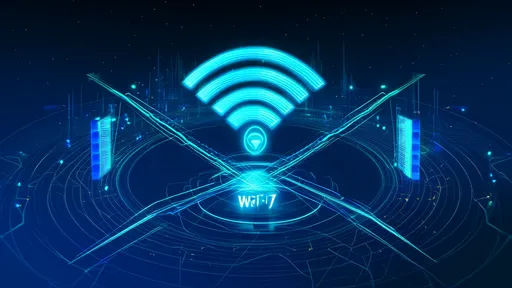
The wireless landscape stands on the brink of its most profound transformation in over a decade, ushered in by the arrival of Wi-Fi 7 and its cornerstone innovation: Multi-Link Operation, or MLO. This is not merely an incremental speed boost or a slight extension of range. MLO represents a fundamental architectural shift in how Wi-Fi devices communicate, promising to dismantle long-standing limitations and finally deliver on the full, seamless potential of wireless connectivity. For years, users have accepted the trade-offs—the dropped video call when moving between rooms, the laggy game session when others stream Netflix, the frustrating wait for large files to transfer. Wi-Fi 7 with MLO is engineered to make these compromises a relic of the past.
To truly appreciate the revolution of MLO, one must first understand the constraint it obliterates. Since its inception, a Wi-Fi device—be it a phone, laptop, or router—could only actively use one wireless band at a time. Even our current tri-band routers, which broadcast separate networks on the 2.4 GHz, 5 GHz, and 6 GHz bands, force a device to choose a single connection. This is like having a three-lane highway but being forced to pick one lane for your entire journey, regardless of traffic conditions, road quality, or your final destination. Your device might be sitting inches away from a powerful, clear 6 GHz signal while it's stubbornly clinging to a congested 5 GHz link because that's the one it connected to first. MLO shatters this paradigm by allowing a device to establish and use multiple connections across different frequency bands simultaneously.
The magic of MLO operates through two primary modes, each addressing different needs. The first is simultaneous transmission and reception. Here, a Wi-Fi 7 device can send data on one band (e.g., the 5 GHz band) while simultaneously receiving data on another (e.g., the 6 GHz band). This full-duplex communication across spectra drastically improves efficiency and slashes latency, the dreaded lag that plagues real-time applications. The second mode is aggregation. In this scenario, data packets are split and sent across multiple links at the same time and then reassembled by the receiver. Imagine needing to send a large book. Instead of handing it over page by page on a single path, you could tear the book into chapters and send multiple chapters down different, faster paths all at once, dramatically speeding up the entire delivery. This aggregation creates a single, fat data pipe that is far wider and more resilient than any single band could provide on its own.
The most immediate and noticeable impact for the average user will be the utter annihilation of latency. For online gamers, VR enthusiasts, and remote workers, latency is the ultimate enemy. A spike of a few milliseconds can mean the difference between victory and defeat in a competitive match or a glitchy, disorienting experience in a virtual world. MLO's ability to dynamically route traffic across the clearest available band in real-time ensures that data packets always take the fastest possible path. If one band becomes congested by a neighbor's network or a sudden download on your own network, the connection instantly and seamlessly fails over to another band without any perceptible interruption. This results in a rock-solid, incredibly responsive connection that feels wired in its reliability.
Beyond blistering low latency, MLO delivers a monumental leap in raw throughput and network capacity. By bonding channels across multiple bands, Wi-Fi 7 devices can achieve theoretical maximum speeds that approach 40 Gbps, far surpassing the capabilities of Wi-Fi 6 and 6E. This is not just about downloading a 4K movie in seconds; it's about enabling a new class of applications and home ecosystem. Think of a modern household: multiple 8K streams, cloud gaming services, AR/VR headsets, and a dozen smart home devices all operating concurrently. MLO allows the network to manage this immense load intelligently, allocating bandwidth where it's needed most without degrading performance for other connected devices. The network capacity is no longer a finite resource to be fought over but a flexible, multi-path highway that can expand to meet demand.
Perhaps one of the most understated yet critical advantages of MLO is its transformative effect on network reliability and coverage. Dead zones and weak signals have long been the bane of Wi-Fi. Traditional mesh systems attempt to solve this by hopping a signal from one node to another, but each hop can introduce latency and potential packet loss. With MLO, a device can maintain a strong, stable connection to multiple access points or mesh nodes at once. If the signal from one node weakens as you move through your home, the device can seamlessly shift its data traffic to a stronger connection with another node without dropping the active links on other bands. This creates an incredibly robust and fluid roaming experience, effectively blanketing an entire property in a consistent, high-performance network without weak spots.
The implications of this technology extend far beyond the living room. In enterprise and industrial settings, Wi-Fi 7 with MLO is poised to be a game-changer. Factories and warehouses relying on automation and IoT sensors require ultra-reliable, low-latency communication for mission-critical operations. MLO provides the redundancy and stability necessary for these environments, where a dropped connection could halt production or cause costly errors. In dense urban areas and public venues like airports and stadiums, MLO will allow thousands of devices to connect simultaneously without bringing the network to its knees, as traffic can be intelligently distributed across all available spectrum.
Of course, the adoption of any new wireless standard is a gradual process. To reap the full benefits of MLO, both the router (or access point) and the client device (phone, laptop, TV) must support Wi-Fi 7. The ecosystem of compatible devices is growing rapidly, with flagship smartphones, laptops, and consumer routers already hitting the market. As with any technological leap, early adoption comes at a premium, but prices will inevitably fall as the technology becomes mainstream over the next few years. The good news is that Wi-Fi 7 devices are backward compatible with older Wi-Fi generations, so the transition will be smooth for mixed-device households.
In conclusion, Wi-Fi 7's Multi-Link Operation is far more than a technical specification on a datasheet. It is the key that unlocks a new era of wireless fidelity. By enabling devices to intelligently and simultaneously harness the unique strengths of multiple frequency bands, MLO directly tackles the core challenges of modern connectivity: latency, capacity, and reliability. It promises a future where buffering, lag, and dropped connections are forgotten concepts, and where the wireless experience is finally indistinguishable from, and perhaps even superior to, a wired one. The revolution is not coming; it is already here, transmitting on all bands at once.

By /Aug 26, 2025
By /Aug 26, 2025

By /Aug 26, 2025
By /Aug 26, 2025

By /Aug 26, 2025

By /Aug 26, 2025
By /Aug 26, 2025
By /Aug 26, 2025

By /Aug 26, 2025

By /Aug 26, 2025
By /Aug 26, 2025
By /Aug 26, 2025

By /Aug 26, 2025
By /Aug 26, 2025

By /Aug 26, 2025
By /Aug 26, 2025

By /Aug 26, 2025

By /Aug 26, 2025

By /Aug 26, 2025

By /Aug 26, 2025